The breadth, indicating the overall health of the market, was slightly positive

rediffGURU Ulhas Joshi answers your mutual fund queries.

The Sensex and Nifty spiralled lower for the fourth session on the trot on Wednesday as investors remained on edge ahead of US inflation data, which will give clues on the Federal Reserve's policy tightening trajectory. Unabated selling by foreign institutional investors and a jump in crude prices also weighed on sentiment, traders said. Despite a firm start, the 30-share BSE Sensex failed to carry forward the momentum and ended at 54,088.39, lower by 276.46 points or 0.51 per cent. During the day, it tumbled 845.55 points to 53,519.30.

Equity indices failed to hold on to their gains in see-saw trade on Tuesday, ending in the red for the third straight session despite a tentative recovery in global equities. The rupee too bounced back from historic lows, but the overall sentiment remained risk-averse amid concerns over economic recovery in a high interest rate scenario. The 30-share BSE Sensex had a choppy start but gained momentum in mid-session trade. However, it succumbed to selling pressure towards the fag end to close 105.82 points or 0.19 per cent lower at 54,364.85. On similar lines, the broader NSE Nifty declined 61.80 points or 0.38 per cent to finish at 16,240.05.

The Securities and Exchange Board of India (Sebi) has asked fund houses operating smallcap funds with a large corpus to share data on their holdings in the total free float of smallcap stocks, according to sources. This is part of the stress tests that the regulator wants fund houses to undertake amid a surge in inflows into smallcap schemes and growing concerns about valuations. Free float refers to the quantum of freely available shares for trading on the stock market.

Titan was the top gainer in the Sensex pack, rising around 4 per cent, followed by HDFC, Nestle India, IndusInd Bank, UltraTech Cement and Bharti Airtel. On the other hand, Bajaj Auto, Tata Steel and NTPC were the laggards.

RBI's fifth bi-monthly monetary policy meet due tomorrow also kept the investors on their toes.
The broad market depicted strength. 1,525 shares rose and 1,131 shares fell. A total of 156 shares remained unchanged

The BSE Midcap and the BSE Smallcap indices pared all intraday gains to end 0.3% and 0.5% lower

Global firm Accenture's fourth quarter results prove that the worst is behind for the Indian information technology (IT) sector, said analysts on Friday (September 27). While the pace and the broadness of recovery is debatable, they said Accenture's results and revenue growth guidance for the next financial year (FY25) reduce downside risks for Indian IT companies.

TCS was the top gainer in the Sensex pack, rising around 4 per cent, followed by ONGC, ICICI Bank, HDFC Bank, Dr Reddy's, HDFC and HCL Tech. NSE Nifty advanced 76.65 points to 14,581.45.
The market capitalisation of BSE-listed companies soared to an all-time high of Rs 406.52 lakh crore on Monday thanks to a rally in equities where the BSE Sensex climbed over 1 per cent. The 30-share BSE Sensex rallied 941.12 points or 1.28 per cent to finish at 74,671.28. During the day, it zoomed 990.99 points or 1.34 per cent to 74,721.15.

'The correction could take two to three months and traders need to be careful.' 'For investors, this could be a good time to nibble in.'
Tata Motors (down 1.7%) was the top loser on Sensex and Nifty, while Lupin (1.6%) gained the most.
Equity benchmark indices Sensex and Nifty on Friday reversed their six-session losing streak and rebounded more than 1 per cent on value buying in auto, IT, financial and energy stocks. Better than expected quarterly financial results of corporates also boosted investor sentiments even as uncertainties persisted over the escalating tensions in the Middle East, according to analysts. In a largely range-bound trade, the 30-share BSE Sensex rose 634.65 points or 1.01 per cent to settle at 63,782.80 points.

Nikunj Saraf, Vice President Choice Wealth, answers your queries.

Five of the 12 BSE sectoral indices ended at 52-week highs; the oil and gas index zoomed by nearly 5%.

The S&P BSE Midcap and the S&P BSE Smallcap indices slipped in red to shed over 1% each

Nifty has a virtual monopoly in the index derivatives segment.

Top gainers in the Sensex pack were TCS, Bharti Airtel, Infosys, Axis Bank, L&T, ITC, PowerGrid, HCL Tech and Tata Steel, ending up to 2.39 per cent.
Broader market outperformed the benchmark indices with S&P BSE Midcap gaining over 1%

Equity benchmark index Sensex buckled under selling pressure for the second straight session to close below the 65k mark on Friday, as investors offloaded IT, teck and metal stocks amid a bearish global trend. Besides, fresh foreign fund outflows also hit investor sentiments, traders said. In a volatile trade, the 30-share BSE Sensex declined 202.36 points or 0.31 per cent to settle at 64,948.66.

Though most analysts expect the global central banks to keep the liquidity tap open, valuations of Indian markets, they say, are beginning to look stretched. Against this backdrop, they remain cautious, with some even expecting a minor correction from here on.

TCS, Bajaj Auto, Adani Ports and Cipla were the top gainers on BSE Sensex while Coal India, GAIL, Dr Reddy's and Infosys lost the most on the index.

'.. if you do not want to take the asset allocation call.'' 'This category of funds can offer optimum risk-adjusted returns.'

Stocks of public sector companies, especially the oil refining and marketing companies (OMCs) - Bharat Petroleum Corporation Limited (BPCL), Hindustan Petroleum Corporation Limited (HPCL) and Indian Oil Corporation Limited (IOC) - logged gains on Tuesday in a weak market. While the Nifty lost nearly 1 per cent in trade on Tuesday, the Nifty CPSE index - a gauge of performance of central public sector enterprises on the National Stock Exchange (NSE) - gained over 3 per cent in intra-day trade. The rally in PSU stocks comes on the back of the BPCL chairman, Arun Kumar Singh suggesting in the company's annual general meeting (AGM) on Monday that the government intends to complete the divestment process in the OMC by March 2022.
Equity benchmarks began the week on a downbeat note on Monday, weighed by heavy selling in market heavyweight Reliance Industries and persisting weakness in global bourses. The rupee plunged to its lifetime low against the US dollar amid unabated foreign fund outflows, underscoring the risk-off sentiment prevailing globally as central banks embark on policy tightening to tame soaring inflation. Slipping for the second straight session, the 30-share BSE Sensex shed 364.91 points or 0.67 per cent to close at 54,470.67.

'In the next one-and-a-half, two months you'll get decent amount of opportunities in the mid-cap and small-cap sector at lower levels.'

Among top losers that dragged down key indices were Infosys, TCS, Reliance, SBI, Tata Steel and ITC, falling up to 2.15 per cent.
The market breadth has turned sharply positive since May amid hopes that a decline in Covid-19 infections will lead to a revival in the economy. At 3.8, the advance-decline ratio (ADR) for May was the best since June 2020. So far this month, the ratio has remained above three - in simpler words, for every declining stock, there were nearly four advancing stocks in May and three this month. ADR is a popular market breadth indicator, with a ratio of more than two signalling an extremely bullish undercurrent.

Omkeshwar Singh, head, Rank MF, a mutual fund investment platform, answers your queries

BSE Midcap and BSE Smallcap outperformed the frontline indices to gain 0.2% and 0.3%

Do you have financial planning or income tax queries? Ask rediffGURU Anil Rego.

Tata Steel was the biggest gainer in the Sensex pack, rising 3.36 per cent, followed by Vedanta, Bajaj Finance, TCS, IndusInd Bank, Infosys, ONGC, Kotak Bank, HDFC Bank, HDFC, M&M and ITC.
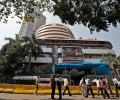
There were more than three losers against every gainer on BSE

Kotak Bank was the top loser in the Sensex pack, falling around 3 per cent, followed by Axis Bank, Sun Pharma, HDFC Bank, Bajaj Finance and Asian Paints. On the other hand, ONGC, PowerGrid and IndusInd Bank were the gainers.

HCL Tech was the top gainer in the Sensex pack, rising over 4 per cent, followed by HDFC Bank, Infosys, NTPC, Nestle India, TCS and HUL. NSE Nifty surged 337.80 points to 14,845.10.

The mutual fund (MF) industry had an action-packed 2023 as it tackled the scrapping of tax benefits for debt fund investors and surging flows into equity funds.

Benchmark indices failed to hold on to early gains and closed in the red for the seventh straight session on Thursday, with participants remaining in wait-and-watch mode ahead of the RBI's interest rate decision. Unabated selling by foreign funds added to the pressure, though a modest recovery in the rupee cushioned the fall, traders said. After rallying in early trade, the 30-share BSE Sensex came under selling pressure in the afternoon session and closed 188.32 points or 0.33 per cent lower at 56,409.96.

Kotak Mahindra Bank was the biggest loser from the Sensex pack, skidding 1.83 per cent, followed by Axis Bank, NTPC, Hindustan Unilever, ICICI Bank, Bharti Airtel, Reliance Industries, HCL Technologies, IndusInd Bank and Nestle. In contrast, Bajaj Finance, Bajaj Finserv, Tech Mahindra, Tata Consultancy Services, Titan, Infosys, HDFC Bank, HDFC and ITC were the gainers.
